How is Stainless Steel Powder-Coated?
Table of Contents
- How is Stainless Steel Powder-Coated?
- Surface cleaning
- Passivating
- Blasting
- Primer and powder coating
Surface cleaning
Before you begin power-coating stainless steel, you must ensure you have a clean workpiece. Surface cleaning removes contaminants or impurities like oil and dirt which can prevent the polymer from binding to the metal.
Passivating
In the passivating process, metals are treated with corrosive chemicals to remove a thin layer of surface material. It's essential this step is done very carefully, as the chemicals used have the ability to cause corrosion. Through passivating, areas in which there is a disturbance of surface distribution of alloying elements - particularly near welds or around scratches or dents - are removed.
Blasting
Even with the care and caution taken in surface cleaning and passivating, impurities can still occur. These final residual imperfections are removed with sandblasting. Following this step, the piece is cleaned carefully and thoroughly to remove residue from blasting.
Primer and powder coating
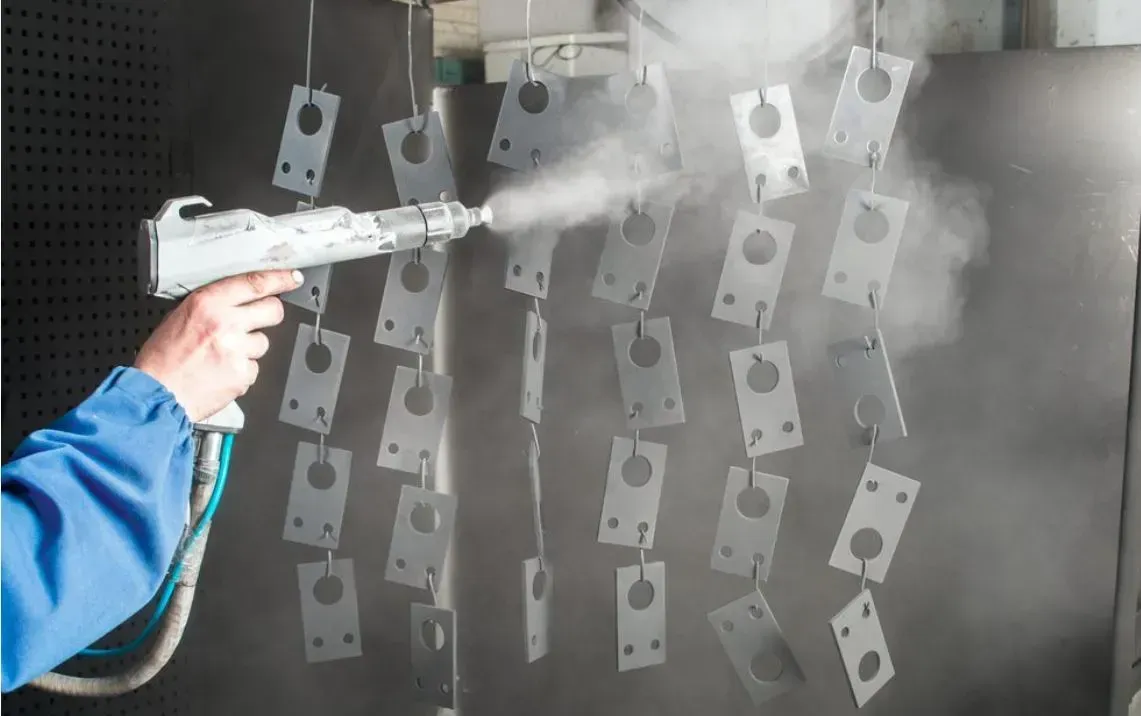
Layers of primer and powder coating are applied to the piece using an electrostatic charge. The use of a charge rather than paint prevents pinholes on the finished surface. While these layers are very thin, they're exceptionally strong.
Decoration
In some instances, decorative treatments might be applied after the primer and powder coating. Patterns or impressions can be created on the metal using a stencil or template.
High-temperature curing
After the powder coat is applied, it needs to be cured or "baked" onto the surface of the steel. The curing process happens at high temperatures (usually at around 185 degrees) and hardens the powder coat so that it is durable and long-lasting. It's important during this step to maintain a consistent temperature for a period of time, often around 15 minutes, before being removed from the oven and cooled.
Curing
The powder coat must be cured or "baked" onto the steel. The metal is cured at a consistently high temperature, usually around 185 degrees, for a period of around fifteen minutes to ensure the effective hardening of the resin. Curing ensures the steel will be durable, long-lasting and able to withstand corrosion, abrasion and scratches.
Need steel fabrication or welding? Contact HardRok Engineering
When you need quality
steel fabrication, welding, rubber lining or labour-hire in Mount Isa, look no further than
HardRok Engineering. We're a local, family-owned business committed to high-quality workmanship, a flexible approach, and our fast turnaround in dealing with breakdowns or repairs. We proudly offer custom designs, manufacturing and installation, all under one roof, so you can be confident whatever your need, we'll meet it to the highest standards.
Contact us today on
07 4749 1770 to speak to our friendly team, to learn more about what we do or to arrange a quote.